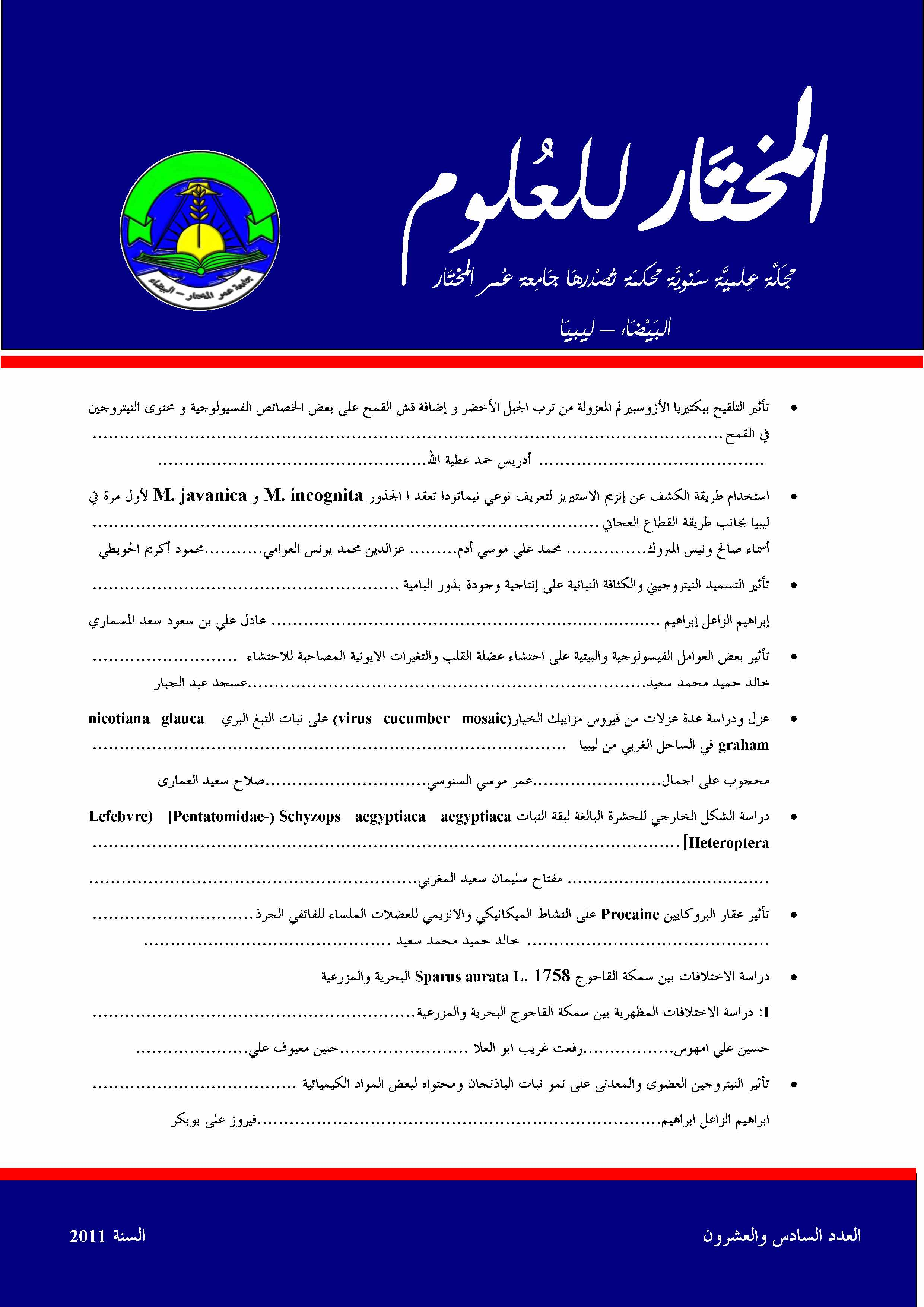
Use of the esterase phenotypes for identification of two Root knot nematodes species, M. incognita and M. javanica for the first time in Libya beside the Pernieal patteren technique
DOI:
https://doi.org/10.54172/mjsc.v26i1.702Keywords:
Root knot nematodes, esterase, identification, LibyaAbstract
Root knot disease caused by Meloidogyne spp. is one of the most distributed nematode plant disease in Libya. This genus is comprises of about 80 species. Nine of them were recorded in Libya and their identification was based on morphological characters in spite of the ability of using other accurate and fast methods such as isozyme phenotype and molecular technique which were not used in Libya so far. In this study the usage of detection of esterase enzyme in identification of M. incognita and M. javanica were achieved for the first time in Laboratory of plant protection department, Omar Almuktar University. That will give chance to confirm the identification of the other recorded RKNs species in Libya.
Downloads
References
أدم، م. ع. م. (1999). دراسة عن النيماتودا المتطفلة على نباتات العائلة الباذنجانية في منطقة الجبل الأخضر ،رسالة ماجستير ، جامعة عمر المختار ، كلية الزراعة ، قسم الوقاية ، الصفحات 106.
الحازمى، أ. س. (1992). مقدمة في نيماتولوجيا النبات ، جامعة الملك سعود ، الطبعة الأولى ، الصفحات 326.
الحويطى، م. أ. (1989). دراسة نيماتودا تعقد الجذور Meloidogyne spp. على الخضراوات والحشائش في بعض مناطق الجبل الأخضر ، رسالة ماجستير ، كلية الزراعة ، قسم وقاية النبات ، جامعة الفاتح ، طرابلس ، الصفحات 49.
Adam, M. A. M., Phillips, M. S. and Blok, V. C. (2005). Identification of Meloidogyne spp. From North East Libya and comparison of their inter and intra specific genetic variation using RAPDS., Nematology 7(4): 599-609.
Adam, M. A. M., Phillips, M. S. and Blok, V. C. (2007). Molecular diagnostic key for individual second stage juveniles, females or males of most common and widely distributed species of root knot nematodes (Meloidogyne spp.).Plant Pathology 56,190-197.
Carneiro, R. M. D. G., Almeida, A. M. R. A. And Carneiro, R. G. (1996). Enzyme phenotypes of Brazilian populations of Meloidogyne spp. Fundamental and applied nematology 19, 555-560.
Dabaj, K. H. and Khan, M. W. (1980). Incidence of root knot disease in tomato and potato and identity of the causal species in the western of the Libyan Jamahiriya Libyan Journal of Agriculture (10): 103-109.
Dickson, D. W., Huisingh, D. and Sasser, J. N. (1971). Dehydrogrnases acid and alkaline phosphates and esterases for chemo taxonomy of selected Meloidogyne, Ditylenchus, Heterodera and Aphelenchus spp,. Journal of nematology (3): 1 16.
Dong, K., Dean, R. A., Forlnum, B. A. and Lewis, S. A. (2001). Development of PCR primers to identify species of root-knot nematodes: Meloidogyne arenaria, M. hapla, M. incognita and M. javanica. Nematropica (31): 271-280.
Eisenback, J. D. (1985). Diagnostioc characters useful in identification of the four most commom species of root knot nematodesw (Meloidogyne spp.). In: Asaaer, J. N. and Carter, C. C.. (Eds) An Advanced Treatisa on Meloidogyne. Vol I. Biology and Control. North Carolina State University Graphics, Raleigh, USA, pp.95-112.
Esbenshade, P. R., and Triantaphyllou, A. C. (1985). Use of enzyme phenotypes for identification of Meloidogyne species. Journal of Nematology (17): 6-20.
Fargette, M. (1987). Use of the asterase phenotype in the taxonomy of the genus Meloidogyne. 1. Stability of the esterase phenotype. Revue de Nematologia (10): 39-43.
Jepson, S. B. (1983). Identification of Meloidogyne species A Comparison of stylets of females. Nematologica (29): 132-143.
Jepson, S. B. (1987). Identifcation of Root knot Nematodes (Meloidgyne species) CAB International, Wallingford, UK PP. 265.
Karssen, G., Hoenselaar, T. V., Verkerk-Bakker, B. and Janssen, R. (1995). Species identification of cyst and root-knot nematodes from potato by electrophoresis of individual females. Electrophoresis (16): 105-109.
Karssen, G. (2002). The plant parasitic nematode genus Meloidgyne Goeldi, 1892 (Tylenchida) in Europe. Brill, Leiden, The Netherlands, pp: 157.
Taylor, A. L. and Sasser, J. N. (1978). Biology identification and control of root knot nematodes (Meloidogyne Species)., Cooperative publication of the Department of plant pathology, North Carolina state University. And U. S. Agency international Development, Raleigh p: 111.
Taylor, D. O. and Netscher, C. (1974). An improved technique for preparing perinal patterns of Meloidogyne spp. Nematologica 20(2): 268 269.
Trudgill, D. L. and Blok, V. C. (2001). Apomictic polyphagous root knot nematodes: exceptionally successful and damaging biotrophic root pathogens. Annual Review of Phytopathology (39): 53- 77.
Whiteh, A. G. (1968). Taxonomy of Meloidogyne (Nematodea, Heteroderidae) with description of four new species Transactions of the Zoological Society of London (31): 263 410.
Zijlsra, C., DonkersVenne, D. T. H. M. and Fargette, M. (2000). Identification of Meloidigyne incognita, M. javanica and M. arenaria using sequence characterized amplififed region (SCAR) based PCR assays. Nematology (2): 847-853.
Downloads
Published
How to Cite
License

This work is licensed under a Creative Commons Attribution-NonCommercial 4.0 International License.
Copyright of the articles Published by Almukhtar Journal of Science (MJSc) is retained by the author(s), who grant MJSc a license to publish the article. Authors also grant any third party the right to use the article freely as long as its integrity is maintained and its original authors and cite MJSc as original publisher. Also they accept the article remains published by MJSc website (except in occasion of a retraction of the article).